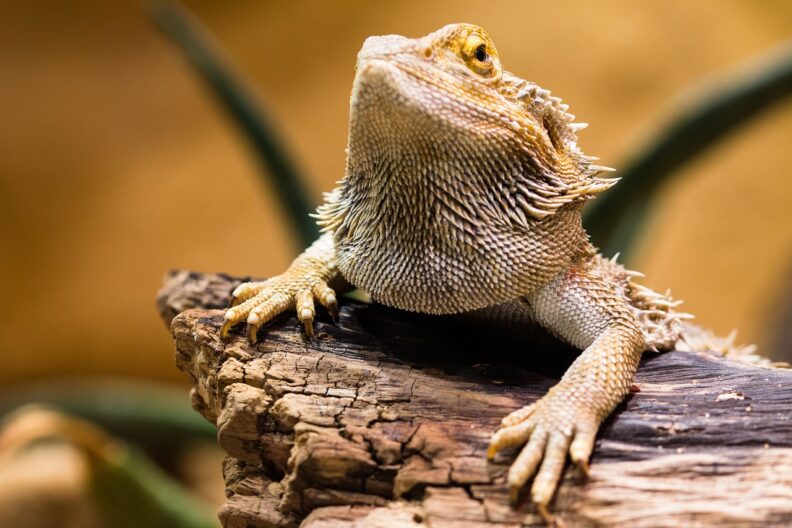
Proper husbandry is the foundation of a healthy pet bearded dragon. Many of the medical problems veterinarians see — including weak legs, soft jaws, yellow fungus disease, and poor growth — are caused by incorrect diet, lighting, temperature, or enclosure setup.
If your bearded dragon seems lethargic, isn’t eating well, or isn’t growing normally, husbandry should be evaluated first.
What does a healthy bearded dragon diet look like?
Bearded dragons are omnivores, meaning they eat both insects and plant material.
Adult diet
- 25% insects (crickets, mealworms, waxworms)
- 50–55% dark leafy greens (kale, romaine, mustard greens)
- 20% chopped vegetables (squash, zucchini, sweet potato)
- Less than 5% fruit (papaya, melon, banana)
Juvenile diet
- Primarily insects to support rapid growth
Supplements
- Calcium powder dusted on insects 1–2 times weekly (juvenile’s need food dusted 4 to 5 times weekly)
- Calcium-to-phosphorus ratio of at least 2:1
- Vitamin D3 supplement once weekly
Most feeder insects are low in calcium. Without supplementation, dragons are at risk for metabolic bone disease.
What enclosure size is recommended?
- At least three times the total body length of the lizard. If you get a large enclosure for a smaller lizard, you may need to artificially make the enclosure smaller to prevent stress.
- Two hiding areas (one warm, one cool) and a basking site
- Clean substrate free of fecal buildup
Daily spot cleaning is recommended. A dragon should not be walking through soiled bedding.
What temperature and humidity are ideal?
Humidity:
- 30–40%
Temperature gradient:
- Basking area: 95–110°F (35°C)
- Cool zone: 75–80°F (24–27°C)
Provide:
- A fresh water dish daily
- Two thermometers
- A humidity gauge
Improper temperature is a common reason a bearded dragon stops eating or gets ill.
What lighting is required?
Bearded dragons require:
- White light (daylight simulation)
- Heat/infrared light
- UV-B light
UV-B lighting is essential for vitamin D3 production and calcium absorption. Without it, dragons can develop weak bones and fractures.
Important reminders:
- Replace UV-B bulbs every 6–8 months for juveniles
- Replace yearly for adults
- Position bulb 30–45 cm above basking area
- Do not place glass, plastic or fine mesh between bulb and lizard
- Sunlight through a window is not sufficient
Why is proper husbandry important?
Improper husbandry can lead to:
- Metabolic bone disease
- Yellow fungus disease
- Immune suppression
- Parasites
- Poor growth
Most serious illnesses in captive bearded dragons are preventable with correct care.
If your dragon is showing signs of illness, contact your veterinarian or a qualified exotic animal veterinarian.
Acknowledgment
This FAQ was developed using information from the senior paper of Angela M. Heggen (’25 DVM), “Yellow Fungus Disease and Metabolic Bone Disease: Two Common Problems of Pet Bearded Dragons,” submitted October 9, 2025, under the guidance of Dr. Nickol Finch.
This information is not meant to be a substitute for veterinary care. Always follow the instructions provided by your veterinarian. Washington State University assumes no liability for injury to you or your pet incurred by following these descriptions or procedures.