For Veterinarians
We are proud to work with our veterinary colleagues around the Pacific Northwest, the greater United States, and Canada, and we want to make referring patients and consulting with WSU veterinarians as easy for you as possible.
Also find out about current clinical studies, see our continuing education opportunities, post a DVM job for our graduates, learn how to become a preceptor, or honor your client’s pet with a donation in their name.
Referrals

A referral request provides the medical history to help us best serve you, your client, and your patient. On the referral form, please provide a case summary and any other details to provide care for your patient. Once the form is submitted we will contact you.
Please allow up to 7 business days for the processing of this referral and for callback and scheduling. If it is more urgent, please note this on the form in the urgency section or call our main line at 509-335-0711 and speak to the specific service directly.
Consultations

We consult with veterinarians seeking advice or an opinion about the evaluation or management of a specific health problem during regular hospital hours. Please complete the consult form to request a consult.
Referring Veterinarians
Questions? Contact us
Mailing addresses to send additional medical records
FedEx/FedEx Air/UPS
Washington State University
Veterinary Teaching Hospital
205 Ott Road
Pullman, WA 99164
US Postal Service
Washington State University
Veterinary Teaching Hospital
PO Box 647060
Pullman, WA 99164-7060
Emergency service walk-in and referral guidelines
The WSU Small Animal Emergency Service is available for walk-in and referral emergency patients seven days a week 7 a.m. to 11 p.m. To help us provide the best care possible, we encourage referring veterinarians to call us in advance at 509-335-0711 before sending a patient our way.
During overnight hours, patients arriving at our front door will be assessed and triaged. Pets with life-threatening conditions will receive immediate stabilization. Wait times may be longer and full diagnostics may be delayed until our emergency service fully reopens in the morning.
If your pet is stable, we may recommend:
- Returning during daytime hours
- Following up with your primary care veterinarian in the morning
We appreciate your understanding as we prioritize the most critical patients overnight. Thank you for trusting WSU with your pet’s emergency.
How to recognize an emergency
When your pet is injured or feeling sick, it is natural to feel scared and anxious, especially in times when you are unsure if the condition requires emergency care. Recognizing the signs of a pet emergency could make all the difference.
Symptoms that may require emergency care
- Trouble breathing
- Trauma, including falls, bites, or wounds
- Collapse, loss of consciousness
- Ingestion of poisons or intoxicants
- Straining to urinate or an inability to pass urine
- Eye injuries
- Repeated vomiting
- Seizures
Sometimes it is hard to know whether to bring your animal in for emergency care. If you are unsure, please call us 509-335-0711.
Forms and information
Please complete and submit a referral form for all small and large animal specialty services. Medical records and images can be uploaded on the form itself, or you can email or fax medical records to us.
Referral forms and consultation requests are for veterinarians only. If you are a client needing medical information, please contact your regular veterinarian.
See below for specific hospital-wide services and testing laboratory forms.
Resources
- Hematology, coagulation, urinalysis, diagnostic cytology testing
- Blood banking
Samples received after 4 p.m. will be tested the next business day unless an afterhours fee is charged. In-clinic patient testing is available on Saturdays from 9 a.m. – noon, will only be preliminary. Send-in/research samples are not processed on holidays or weekends. After-hours fee will be assessed for samples submitted after 4 p.m.
Sample Submission
- Please include a completed Clinical Pathology requisition form. Include the veterinary clinic/veterinarian, address, and fax/telephone information.
- Patient information should include full name, age, sex, species/breed and history.
- All samples should be labeled with patient name.
- Date of blood draw or sample collection should be on the form.
- Samples should be received same day or shipped overnight on a cold pack, unless it is a slide cytology.
- Serum, plasma samples should be separated from the RBCs.
- An air-dried differential slide should be made if a CBC is ordered. The slide should be protected from freezing/heat exposure and should not be packaged with formalin fixed tissues.
- NOTE: Ideally, shipping over the weekend or a holiday is not optimal for sample integrity. It is best to avoid this unless necessary.
- Fluid cytologies, when possible, should have an air-dried direct slide made to preserve cellular integrity.
- Cytologies should include sample site or fluid type with description of the lesion and any relevant history.
- Cytology samples should not be packaged with formalin fixed tissues.
- For cytology submissions requiring additional information, please attach a second page, preferably typed.
Resubmit a Sample
Samples are received under the same accession number and are not charged an additional test fee unless there is an additional shipping charge. To resubmit samples, follow the original guidelines for submitting specimens. Samples cannot be resubmitted after 14 days.
Saving Samples
Samples submitted to the Clinical Pathology Lab are saved for one week in the refrigerator. If additional testing is desired during this time, please notify the laboratory to determine if there is enough volume and sample integrity to run the test. CSF serum titer samples are saved frozen fortwo months. CSF titer samples are refrigerated for two weeks. Slides for cytologies are kept for a minimum of three years.
Fee Information
In-clinic patients: Clinical Pathology services for in-house patients are charged to the patient account upon accessioning and are invoiced to the client at time of discharge. Any additional testing requested by the clinician on the case after discharge will be charged to the client and billed.
Send-in sample testing: There is no additional fee for send-in specimens. The Clinical Pathology laboratory cannot receive samples sent in by the owner without an attending veterinarian on the case. The test results and invoice will be given to the attending veterinarian. We can only give results to the attending veterinarian.
STAT requests include an additional fee and are not available for all tests.
All fees are subject to change. Please direct invoice and billing inquiries to the accounting department at 509-335-0816. For test pricing contact the Clinical Pathology laboratory at 509-335-0745.
Miscellaneous Fees
| Fee | Details |
|---|---|
| Stat charge | |
| After-Hours fee | After-Hours fees will apply starting at 4 p.m. Monday-Friday, holidays, weekends (excluding in-clinic patient testing from 9 a.m. to noon Saturdays) |
| Federal Express shipping fee | Most send-out tests will also have a FedEx shipping and handling charge applied |
| Antech IDEXX shipping and processing fee | Some send-out tests will have a sample processing fee instead of a FedEx fee |
Please contact us at 509-335-0754 or wsuholter@vetmed.wsu.edu.
Our Holter service provides
- All necessary equipment and instructions for a 24-hour digital Holter monitor recording
- A full report with recommendations from a WSU board-certified veterinarian
- Discounts on recheck Holter monitors for long-term care
Note: The Holter monitor report and recommendations will be provided to the ordering doctor unless communicated otherwise. Please note that the report will often have treatment recommendations. We can prescribe medication if the patient was seen by WSU Cardiology within the last 12 months. Medication refills can also be arranged with the local veterinary team.
Certain breeds of dogs and cats have a genetic predisposition that causes adverse reactions to commonly used medications. Collies, Australian shepherds, and long-haired whippets are some of the commonly affected breeds.
WSU offers a test to determine if a dog or cat has the MDR1 gene mutation.
Washington Animal Disease Diagnostic Laboratory (WADDL)
- Bacteriology, histopathology, serology, mycology, necropsy, toxicology, parasitology, molecular diagnostics and virology testing
Washington State University Veterinary Medicine Extension helps build connections between industry, producers, veterinarians, and students throughout the state of Washington.
Veterinary Continuing Education
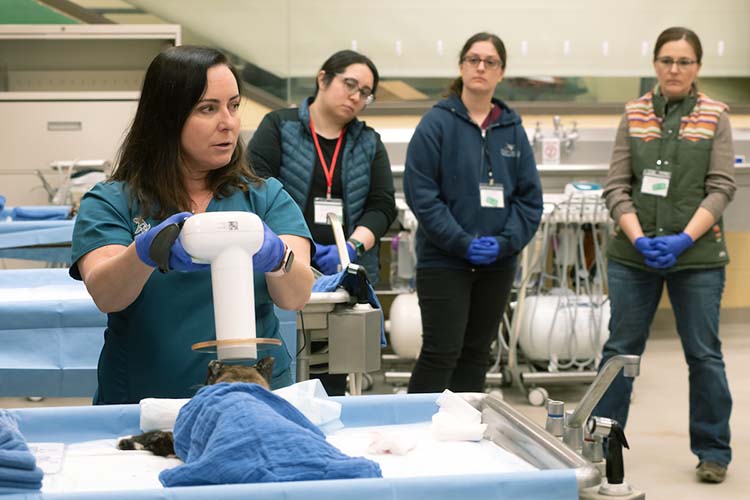
Small and large animal continuing education for veterinary professionals.
Clinical Studies
- Effects of omeprazole on the esophageal microbiome in brachycephalic dogs compared to healthy controls Evaluate potential differences in microbiome response to omeprazole between brachycephalic dogs and non-brachycephalic dogs.
- Evaluating the changes in D-dimers during the perioperative period of canine ovariohysterectomies Characterize the changes in D-dimer concentrations in dogs undergoing a routine spay procedure.
- Use of Nonsteroidal anti-inflammatory drugs in healthy cats under anesthesia and the evaluation of kidney function Kidney disease is a progressive condition that is often difficult to detect in its early stages. This study aims to identify early markers of kidney changes in cats undergoing anesthesia using small samples of blood, urine, or saliva.
- Testing the effectiveness and tolerance of local immunotherapy on soft tissue sarcomas in dogs Testing the effectiveness and tolerance of local immunotherapy on soft tissue sarcomas in dogs.
- Dog aging project TRIAD study Trial of Rapamycin in Aging Dogs
Do you have a job or externship opportunity to share with our DVM students?
Honor your clients’ pets with a donation in their name.
The WSU Pet Memorial Program provides a way for you to offer meaningful comfort to clients who have lost an animal companion.