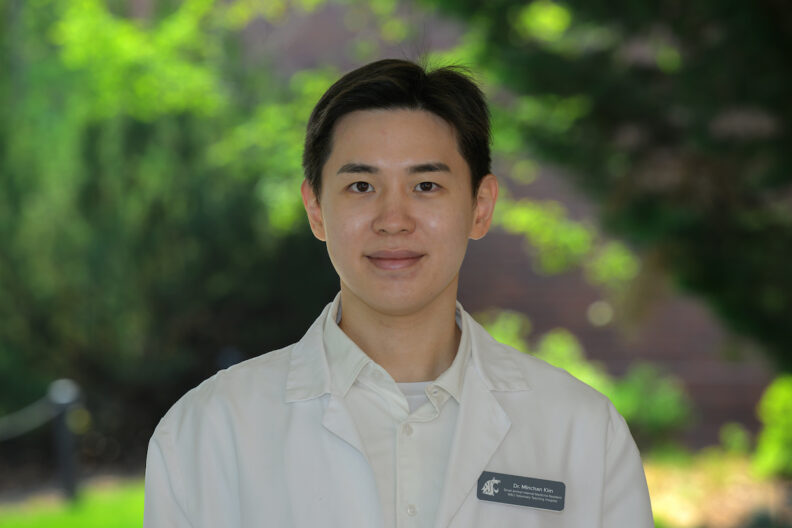
Dr. Minchan Kim is a resident veterinarian in small animal internal medicine at the WSU Veterinary Teaching Hospital. Resident veterinarians are doctors who have completed veterinary school and are now pursuing advanced specialty training, combining hands-on patient care with intensive clinical education under the mentorship of board-certified faculty.
Originally from Busan, South Korea, Kim earned his Doctor of Veterinary Medicine degree from Gyeongsang National University before coming to WSU. His path to internal medicine was shaped by his interest in infectious diseases, including three years of service in the Korean Army helping manage disease control efforts during the COVID-19 pandemic. Today, he works with some of the hospital’s most complex medical cases while also helping train the next generation of veterinarians. He recently answered a few questions about his career path, residency experience, and life at the Veterinary Teaching Hospital.
What drew you to small animal internal medicine?
After I graduated from vet school, I served in the Korean Army for three years, and my job was to control infectious diseases in my area. Since I served from 2020 to 2023, most of my work was controlling COVID-19, but while doing that, I became interested in infectious diseases, which are part of internal medicine.
Then, when I was an intern, I felt like internal medicine always had the most complicated cases. I saw other services come to internal medicine when they weren’t sure what was going on or something seemed odd. So, I thought internists were the doctors closest to the answer, and I still think that. We see a lot of mysterious cases at a referral hospital, so I don’t always have an answer for my patients, but I think we’re the ones who get the closest.
What first sparked your interest in veterinary medicine?
I was interested in biology since I was a kid, but I wasn’t sure exactly what I wanted to be. When I was choosing my career, I wanted to be some kind of doctor. Helping animals that can’t tell us how they feel or what’s wrong seemed very rewarding to me, so I decided to become a veterinarian.
What does a typical day look like for you as a resident at the Veterinary Teaching Hospital?
It depends on the week. On outpatient weeks, I usually start the day with rounds. After rounds, we start seeing patients. Usually, an assigned student takes the history and performs the physical exam first. Then we review those findings together and work through the patient’s problem list, differential diagnoses, and diagnostic plan for the day. Once we have a diagnosis, we put together a treatment plan and discharge the patient.
What do you find most rewarding about residency training?
Since I’m in an academic residency, I get to see patients and teach students at the same time, and that is really rewarding. When I see a fourth-year student improve during their rotation, I feel as happy as when I see a patient get better.
Do you have a favorite case or patient that has stuck with you during your training?
As an internal medicine resident, I have many patients who have stuck with me. I’ve followed many of them for over a year, and it’s always great to see them and their owners again.
It’s hard to choose a favorite, but if I had to pick one, it would be Ruth, a 3-year-old goldendoodle with a fungal infection. We treated her three times a week for a month. She’s still fighting the infection and isn’t cured yet, but she’s doing great. I really hope we can cure her.
Who has been an important mentor or influence during your training at WSU?
Dr. Jillian Haines is my residency mentor, and I think she influenced me the most, especially when I first started residency. I was very nervous rounding with her on my cases at first because I wasn’t confident enough, but through her teaching, I picked up her knowledge and her way of thinking. I think my style of practice is closest to hers, or I hope it is, whether she agrees or not.
What do you hope to do when you complete your residency?
I’m not sure what I will be doing next year, to be honest. I would like to stay in academia for a while and am looking for a position. Even though I am an internal medicine doctor, I enjoy doing things with my hands, so in the future I would expand my skills in doing more interventional procedures or ultrasounds.
What advice would you give veterinary students who are considering residency?
I would say residency is not as harsh as you think, but it definitely takes a huge commitment. You have to go through years of life with sleep deprivation, uncertainties, self-doubt, and exams. Still, I can’t imagine not having done my internal medicine residency, because I wouldn’t have grown as a doctor or as a person without it. One piece of advice is to respect your colleagues, whoever they are, because everyone in veterinary medicine is working to help our patients.
How is the WSU Veterinary Teaching Hospital different from the other schools, clinics or hospitals you’ve been part of?
I definitely think WSU VTH has the most welcoming atmosphere. I never hesitate to go to other departments to ask about my patients or to talk to faculty when I need advice. Also, we’re far from any big city, and our clients come from all over the Pacific Northwest. Their dedication to their animals is really special. A lot of them drive several hours just for a re-check appointment.
Outside of the hospital, how do you like to spend your time?
During the first half of my residency, I spent most of my free time reading and studying. As I’ve gained experience, I’ve learned to utilize my time off better. I try to go to the gym regularly, and I try to visit as many places in the Pacific Northwest as I can, especially the national parks. So I’d say traveling and exploring the Pacific Northwest is my new hobby.