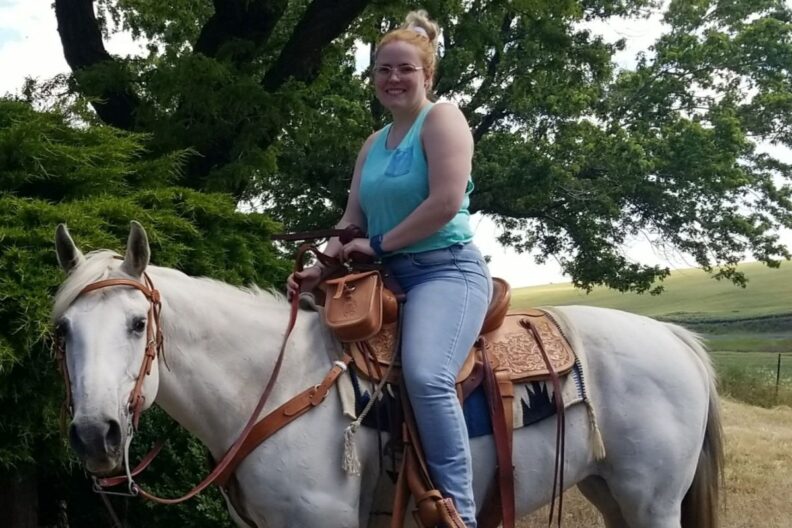
For nearly eight years, Randi Taylor has been a veterinary assistant in our Large Animal service, where she now spends her time as one of our night assistants helping to oversee students and patient care.
Originally from Ione, Washington, Randi graduated from Washington State University with a bachelor’s degree in animal science.
She has two horses – a 31-year-old mare named Lacey and an 8-year-old gelding named Traveler – in addition to a 9 year old tuxedo cat named Hippo and a 9-year-old Australian shepherd named Arkham.
What is your typical day like at the Veterinary Teaching Hospital?
I work as one of the two current large animal night assistants where I help oversee the students and patient care overnight. Since I work overnights, my nights are fairly unpredictable, though there are a lot of repetitive days.
Most days consist of providing support to the students to ensure that they are safe and that the patients are cared for to the best of our ability. Since every student is required to take the large animal ICU rotation there is a wide range when it comes to level of experience and handling capabilities of the large animals. I help the students who are less confident by teaching them how to safely handle the animals to effectively provide the required treatments and answer any questions or concerns they may have. I also maintain the supplies in the equine department and complete orders from the materials department and pharmacy to make sure that the commonly used items needed to treat our patients are always available.
On other nights, we have a wide range of emergencies that can come in at any time. When we have an emergency, I prep any supplies and spaces that may be needed, including prepping the surgery suite in case we end up in an emergency surgery. I also ensure that the students are prepared to take part in the emergency with the house officer that is on-call. This includes ensuring we call in all the students so we have enough people to not only manage the emergency but also ensure the patients in the hospital still receive the best level of care that we can provide. I also make sure they know what their roll in an emergency looks like: are they assisting by getting a full history so we can immediately take the patient and start administering care, or are they going to take primary on the case and get the hands-on experience to work similar cases by themselves in the future, or are they going to maintain the current patients. I also try to make sure they know what information is important for them to know: what history is required in that specific instance that we need to know as soon as possible; what the work up will look like so they know what steps need to be taken so the patient can be taken care of as efficiently as possible; what information their treatment plan will look like, so they can start thinking thru the process to determine what the best course of action will be for that patient.
Once the emergency arrives, I am typically managing the patient to ensure everyone remains safe. Horses and other large animals are not the most rational when they are in extreme pain and can quickly cause a situation to become extremely dangerous to handle. I keep the students out of the way of thrashing horses and restrain the patient so the doctors can safely approach that animal to administer any care needed. Really, my whole job is to make sure everyone is able to walk away at the end of that emergency. I also help direct the emergency, being able to anticipate what the next step will be and what items are needed so we do not have to stand around and wait on items is an important part of my job to make sure the patients are getting the best chance of survival. Once the emergency is all said and done, I also clean up after and prepare for the next day so we can continue to help patients effectively.
What made you want to work in veterinary medicine and at the Veterinary Teaching Hospital?
I have always loved animals and raised a number of different species growing up in a rural community. Before coming back to Pullman I was working at a shelter in Spokane and got a taste of vet med there. I really liked being able to learn more about that side of animal care and loved being able to help the animals that needed it most. Unfortunately, my time at the shelter was not the best for my mental health and I decided it was time to look at other options and ended up finding this position. It was a great opportunity to advance that knowledge, but did not require me to go to vet school, which I had no interest in.
What is your favorite thing about your job? What are the most rewarding aspects?
I think my favorite part of this job is being able to watch the students grow their confidence with large animal medicine and vet med overall. I love nothing more than to watch a student who was afraid to enter the stall on day one being able to medicate a horse by themselves at the end of the rotation. Their confidence grows so much with all the hands-on experiences they get on the overnight rotation.
What are your career goals? Where do you see yourself in 5 or 10 years?
I am not positive where I want to be in the next 5 or 10 years. I love watching the students grow but also being on night shift makes it difficult to manage daily tasks sometimes since most people are on the opposite schedule. I may end up getting my technician license and moving into a day shift, go to another hospital, or travel helping animals. Who knows, and I think that is one of the best things about vet med. You can take that knowledge anywhere and be able to help the animals around you.
What do you like to do outside of work?
Outside of work I also volunteer full time for a nonprofit organization called HOBY – it is a leadership conference for sophomores in high school that focuses on empowering them to be more active members in their community. I am the treasurer for the Washington state branch and help with grant writing and fundraising so we can reach as many students as possible. I also enjoy spending time with my animals and my extended family whenever I can. I enjoy being outdoors as much as possible or curled up in a comfy spot reading or working on a random crafting project. Anything really to keep my hands and mind busy.
What advice would you give to pet owners?
If you are concerned about your Large Animal for any reason, call your local veterinarian. The most common emergency in horses is colic and is also one of the leading causes of death. The longer you wait to get a colic taken care of, the lower the chance of survival. We would much rather be able to medically manage your horse with fluids and walking than take them to a stressful and costly surgery that may not have a happy ending. The same can be said of lacerations, chokes, or any other emergency. The longer you let it go untreated, the more likely it will be to have additional complications.