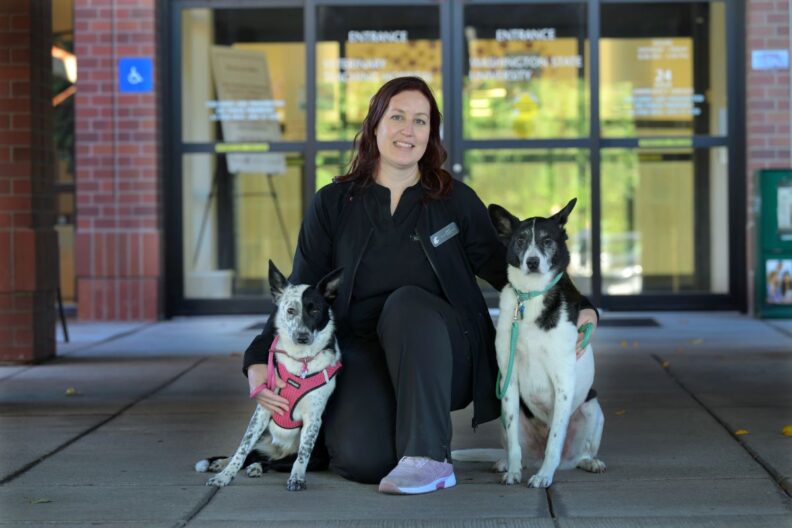
Depending on the day, Lori Tierney can find herself helping to care for pets and animals ranging from birds and lizards to dogs and camels. Lori joined our team at the Veterinary Teaching Hospital in June of 2023 as float technician, meaning she works with all the services at the hospital.
Lori has an associate’s degree in veterinary technology and bachelor’s in wildlife biology, and she is also a licensed veterinary technician.
She shares her home with her Formosan mountain dog mix, Barley; border collie/heeler mix, Poppy; and tuxedo cat, Clover.
What is your typical day like at the Veterinary Teaching Hospital?
As a float technician, no two days are the same. I get to work throughout the hospital, filling in for whichever department is in need of a Licensed Veterinary Technician that day. I tend to fill in for anesthesia, ICU, and exotics the most, but can also jump into surgery, internal medicine, cardiology, integrative medicine, community practice or ag animal if needed. Depending on where I land that day, I provide nursing support to hospitalized patients, intake daily appointments and accommodate the necessary imaging and sample collection per doctor request, anesthetize patients for surgery or outpatient procedures, and support communication between clients, clinicians and staff, all while supporting our fourth-year vet students to gain confidence with their clinical skills.
What made you want to work in veterinary medicine and at the Veterinary Teaching Hospital?
In the years between high school and completing my undergrad in wildlife biology, I worked for both the U.S. Forest Service and National Park Service as a park ranger, seasonal wildland firefighter, and hydrology technician. After college I began work as a field researcher, tracking endangered owls in Yosemite National Park. When the project I was part of began collecting biological samples for genetic and health analysis, I felt the draw toward veterinary medicine. So instead of continuing on with a master’s degree, I focused on a degree in veterinary technology with the goal of doing field conservation work with wildlife locally and abroad.
What is your favorite thing about your job?
My favorite thing about being a float is the variety. I get wanderlust if I’m stuck in the same place for too long, so getting to move throughout the hospital helps satiate that desire to mix things up. I enjoy getting to know how each department flows and being familiar with all staff, which helps to facilitate communication and continuity of care for our patients.
What do you like to do outside of work?
I love to travel and try to do so as much as possible, and usually try to incorporate wildlife work whenever I can. Most recently, I returned to Nepal with a conservation grant to initiate a foundational elephant health camp focusing on the health and welfare of captive elephants. I’ve also been fortunate to travel to Peru for work with spectacled bear conservation, and to the southern U.S. for endangered reptile surveys. At home, I’m kept busy with an active puppy and enjoy gardening and home renovation projects.
What advice would you give to pet owners?
When looking to add a pet to your family, be sure to avoid trends in favor of an animal that will suit your lifestyle long term. And pet insurance can be a lifesaver!