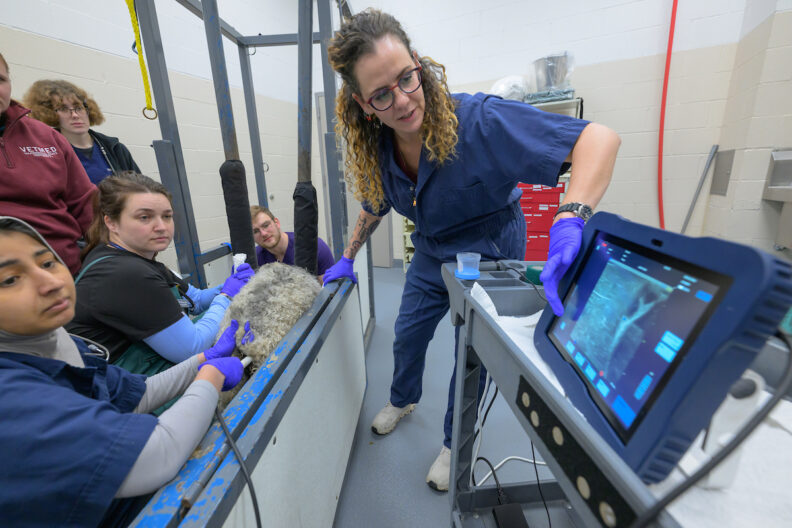
Reproductive specialists for cattle, equine and small ruminants like sheep and goats can be difficult or even impossible to find in many areas of the country.
In Pullman, Washington, however, Washington State University’s Veterinary Teaching Hospital is home to one of the nation’s leading comparative theriogenology services, providing advanced reproductive care for species ranging from cats and dogs to horses, cattle, pigs, camels, goats and sheep.
The service, which supports veterinarians and livestock owners across Washington, Idaho, Montana and much of the Pacific Northwest, is staffed by board‑certified theriogenologists, who are among only a handful of such specialists in Washington certified by the American College of Theriogenologists. Their work is critical to maintaining herd health and productivity, particularly as many rural regions face shrinking access to veterinarians trained in complex reproductive care.
“We provide advanced reproductive care for a wide range of species and serve as a referral resource for complex or high-risk cases,” said Dr. Michela Ciccarelli. “Our focus is on supporting herd health, animal welfare and the long-term success of producers and ag animal owners in the region.”
The service offers reproductive exams, pregnancy ultrasound, breeding‑soundness evaluations, dystocia management, artificial insemination, neonatal care and 24/7 emergency support, along with advanced laparoscopic procedures — including embryo transfer and oocyte aspiration — offerings rarely available at mixed‑animal practices.
“We try to do everything laparoscopically when it’s appropriate,” Ciccarelli said. “In ruminants, that’s not commonly offered, but it means less pain, less stress and faster recovery, which matters when these animals are your livelihood.”
The service is also preparing to offer in‑vitro fertilization for ruminants beginning next fall.
Ciccarelli said the team regularly serves as a resource for producers and referring veterinarians, offering consultation, advanced testing and specialized procedures for complex reproductive cases.
Training future veterinarians is also central to the program. The team regularly trains residents completing their theriogenology specialty, and fourth‑year veterinary students directly assist with clients.
“Our students are the keystone of what we do,” Ciccarelli said. “Clients with ruminants understand how important it is to train the next generation because there’s a lack of veterinarians with these skills. They’re incredibly receptive to student involvement.”
Among veterinary colleges, the service is one of the few using a comparative model, meaning the team manages ruminant, equine and small‑animal reproductive cases within a single service. That exposure is a major advantage for aspiring veterinarians training at WSU.
“We can see a goat, a mare and a dog all in the same day,” Ciccarelli said. “Most universities separate or only offer services for specific species.”
Collaboration across the College of Veterinary Medicine is another important aspect of the service. Ciccarelli and her team regularly partner with researchers and clinical faculty, including School of Molecular Biosciences Regents Professor Jon Oatley, who leads WSU’s Resilient Livestock Initiative, an effort that combines functional genomics, artificial intelligence and other advanced technologies to enhance the resilience of livestock.
These collaborations connect day‑to‑day herd challenges with cutting‑edge reproductive research, benefiting producers and students alike.
“When animals are your livelihood, you can’t afford infertility or reproductive loss,” Ciccarelli said. “What we do matters — for producers, for food security and for the animals themselves.”