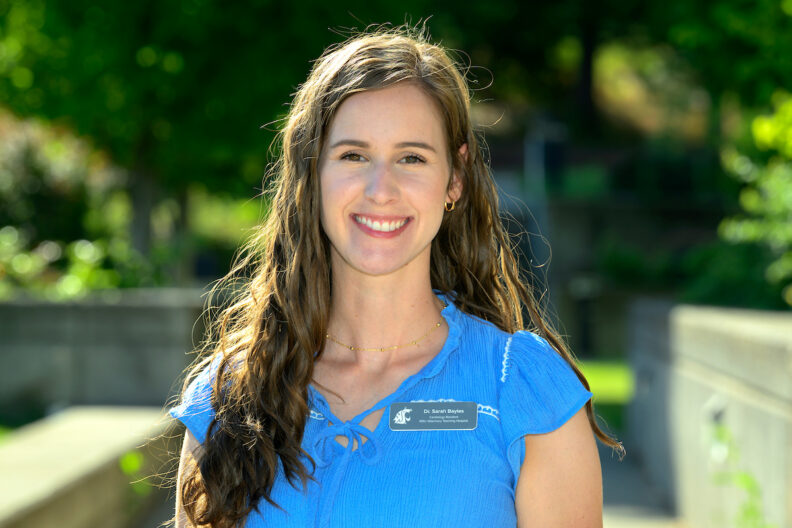
The WSU Veterinary Teaching Hospital’s resident veterinarians are highly trained doctors who have completed veterinary school and are now pursuing advanced, intensive specialty training. As part of the cardiology service, residents like Dr. Sarah Bayles work directly with patients and clients while learning from and collaborating with board-certified faculty in a fast-paced, team-based hospital environment.
Residency training combines advanced education, hands-on patient care, and increasing clinical responsibility, preparing veterinarians like Dr. Bayles to become future specialists while helping ensure patients receive high-quality, comprehensive care.
Originally from Corinne, Utah, Dr. Bayles earned a Bachelor of Science in Animal, Dairy, and Veterinary Science with minors in Chemistry and Biology from Utah State University in 2020, followed by her Doctor of Veterinary Medicine from WSU in 2024.
She recently took some time to answer a few questions about her path to veterinary medicine, her interest in cardiology, and what residency training looks like at the WSU Veterinary Teaching Hospital.
What is your specialty area of veterinary medicine and what drew you to it?
I am a first-year cardiology resident at the Washington State University Veterinary Teaching Hospital. In my opinion, cardiology is the best specialty because it blends so many aspects of medicine — advanced imaging such as echocardiography, ECG interpretation, medical management of a wide range of cardiac diseases, and minimally invasive procedures that can dramatically improve quality of life and, in some cases, restore a normal lifespan for the patient. I find cardiac physiology fascinating, especially how interconnected every component of the cardiovascular system is.
What first sparked your interest in veterinary medicine?
I grew up in a small town, loved science, and loved animals, so becoming a veterinarian was something I dreamed about from a young age. Over the years I had quite the menagerie — hamsters, a chinchilla, a horse, goats, chickens, ducks, dogs, and cats — and I loved learning everything I could about each one. I would even ask for species-specific animal books for Christmas and my birthday. Although I took a few detours along the way and explored other educational paths, human medicine and agricultural education, based on well-meaning advice I received, I ultimately realized that veterinary medicine was my true passion and decided to pursue it fully.
What does a typical day look like for you as a resident at the Veterinary Teaching Hospital?
A typical day as a cardiology resident can look a lot of different ways! On appointment days we might see anything from routine murmur evaluations to arrhythmias or complex congenital heart defects. Some come through the doors stable, others in critical condition. We also help other services with cardiology consults throughout the day and with more emergent ER cases. Once a week we have a dedicated procedure day where we do minimally invasive cardiac catheterization procedures like balloon valvuloplasties, stent placements, PDA occlusions, and pacemaker implantation. No two days are ever the same, and I really enjoy the mix — from straightforward cases to rare and challenging ones.
What advice would you give veterinary students who are considering residency?
Just because you think residency isn’t for you, don’t count it out. Until the middle of my fourth year of veterinary school, I was fully planning to go into mixed animal general practice — that had been my goal from the very beginning. I grew up working on a dairy and in a rural community where the veterinarians I worked with treated everything, so that path felt natural.
Then I took a cardiology rotation a couple of months into fourth year, and everything shifted. I finally saw what specialty medicine looked like and absolutely loved it. The cardiology team welcomed me in — faculty and residents walked me through echocardiograms and ECGs, and I even had the chance to scrub in on procedures. That experience is when I truly fell in love with cardiology.
When I decided I wanted to specialize, I worried I was “late to the game,” but things eventually fell into place. Fast-forward through two Match cycles, and I’m now back as a cardiology resident. Never say never. It’s OK to shift gears, change paths, and discover what truly fits you — even if it isn’t what you originally planned.
Outside of the hospital, how do you like to spend your time?
Outside of residency, I spend most of my free time with my family. My 4-year-old daughter keeps my husband and me on our toes, and she loves animals just as much as we do. One of her favorite things is visiting the teaching hospital to see the patients and say hello to everyone. On my weekends off, we try to get outdoors as much as possible (especially during the warmer months) — whether that means going to the lake, taking a hike, or exploring a new park. I also have a serious love for chocolate and ice cream, which my daughter has definitely inherited, so we make dessert outings a frequent treat.